
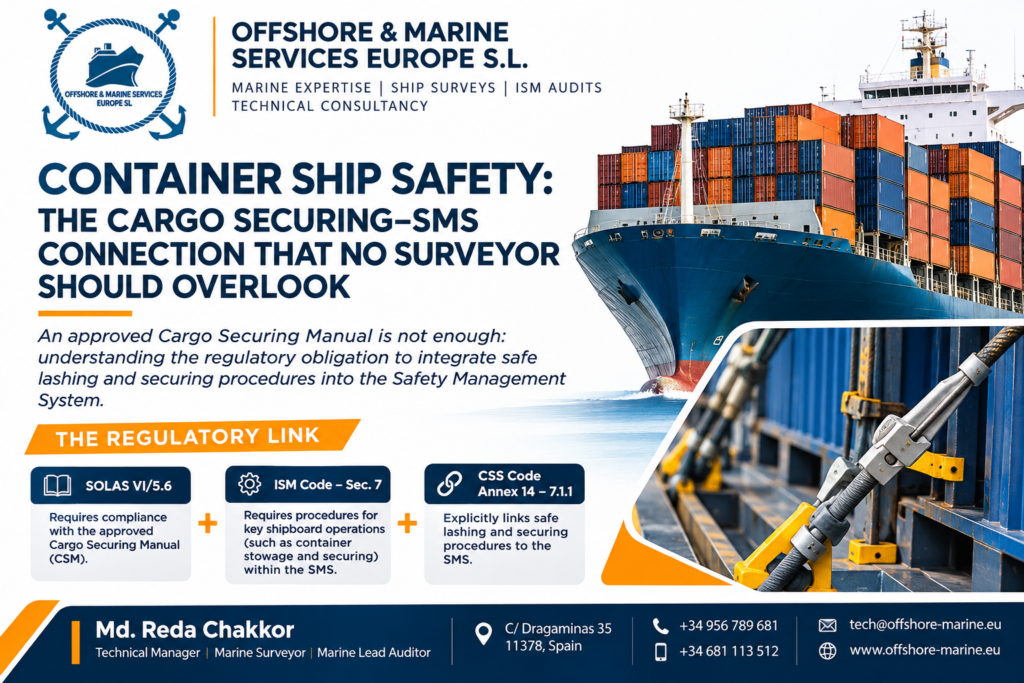
An approved Cargo Securing Manual is not enough: understanding the regulatory obligation to integrate safe lashing and securing procedures into the Safety Management System.
Md. Reda Chakkor
Technical Manager | Marine Surveyor | Marine Lead Auditor
OFFSHORE & MARINE SERVICES EUROPE S.L.
CARGO SECURING MANUAL vs SMS: THE MISSING LINK ON CONTAINER SHIPS
Having an approved Cargo Securing Manual is not enough. How does the SMS ensure its effective implementation?
During container ship condition surveys and internal ISM audits, the presence of an Administration-approved Cargo Securing Manual (CSM) is normally verified. However, a more fundamental question is often overlooked:
Where is the implementation of the Cargo Securing Manual addressed and controlled within the vessel’s Safety Management System?
This is not merely a documentation issue. It is a regulatory and operational requirement.
1. THE REGULATORY CONNECTION
Three regulatory references establish the relationship:
SOLAS Chapter VI, Regulation 5.6 – The Technical Requirement
Requires containers and other cargo units to be loaded, stowed and secured throughout the voyage in accordance with the Administration-approved Cargo Securing Manual.
This establishes WHAT the vessel must comply with: the approved CSM.
ISM Code, Section 7 – The Management Requirement
Requires the Company to establish procedures, plans and instructions for key shipboard operations affecting safety.
Container stowage and securing are key shipboard operations. Consequently, the Company must establish within its SMS how compliance with the approved CSM is ensured.
This establishes HOW the vessel manages compliance.
IMO CSS Code, Annex 14, Section 7.1.1 – The Explicit Link
This is the most important reference.
It specifically states that procedures for safe lashing and securing operations should be included in the ship’s Safety Management System as part of the ISM Code documentation.
This provision removes any ambiguity regarding the relationship between cargo securing procedures and the SMS.
2. WHAT IS THE ACTUAL LINK THAT MUST EXIST?
The relationship can be understood through three complementary elements:
| Regulatory / operational element | Its purpose |
|---|---|
| SOLAS VI/5.6 | Requires compliance with the approved CSM. |
| Approved Cargo Securing Manual | Establishes the technical securing arrangements applicable to the vessel. |
| SMS – ISM Code Section 7 | Establishes the management procedures ensuring that those arrangements are properly implemented. |
In practical terms:
- The CSM establishes the approved technical requirements.
- The SMS establishes the company’s procedures for implementing and controlling those requirements.
- The CSS Code Annex 14.7.1.1 explicitly connects safe lashing and securing procedures with the SMS.
Therefore, the SMS and CSM cannot be treated as two independent documents operating separately. They must be functionally connected.
3. WHAT MUST THE SURVEYOR VERIFY ON BOARD?
During a container ship condition survey or internal ISM audit, the objective is to establish whether this regulatory connection actually exists.
The following checks are essential:
1. SMS DOCUMENTATION
Identify the SMS procedure governing cargo operations and verify:
- Is container stowage and securing specifically addressed?
- Does the procedure establish compliance with the approved CSM?
- Is the approved CSM identified as the governing technical document?
- Are responsibilities for ensuring compliance clearly assigned?
2. DOCUMENT CONTROL
Verify that the approved CSM is included in, or properly referenced by, the vessel’s controlled documentation system.
Check that the applicable revision is available and that amendments are properly controlled.
3. OPERATIONAL CONNECTION
Check whether the SMS establishes how the vessel ensures that the approved CSM is actually applied during cargo operations.
The objective is not simply to find a reference to the CSM in the SMS, but to establish that the SMS provides an effective management framework for its implementation.
4. VERIFICATION OF IMPLEMENTATION
Interview the Master and Chief Officer to establish whether they understand the relationship between the SMS procedures and the approved CSM.
Compare documented procedures with actual shipboard practices and available operational records.
4. WHEN IS THERE A POTENTIAL ISM NON-CONFORMITY?
A potential non-conformity exists when the vessel has an approved CSM but the Company’s SMS fails to establish the necessary procedures for safe lashing and securing operations.
For example:
- The CSM exists, but no SMS procedure addresses safe lashing and securing.
- The SMS does not establish how compliance with the CSM is managed.
- The CSM is not properly controlled or referenced within the vessel’s documentation system.
- The documented SMS arrangements are not implemented in practice.
The relevant references are CSS Code Annex 14, Section 7.1.1, and ISM Code Section 7, depending on the evidence.
FINAL MESSAGE FOR THE SURVEYOR
Do not stop your inspection after confirming that an approved Cargo Securing Manual is available on board.
The critical question is:
HOW DOES THE VESSEL’S SMS ENSURE THAT THE APPROVED CARGO SECURING MANUAL IS IMPLEMENTED AND COMPLIED WITH?
SOLAS establishes the obligation to comply with the approved CSM.
The ISM Code establishes the requirement for procedures governing key shipboard operations.
The CSS Code, Annex 14, Section 7.1.1, explicitly connects safe lashing and securing procedures with the SMS.
An approved CSM without an effective SMS implementation framework is only half of the compliance picture.